Newly promoted managers may understand that they need to address performance concerns, but knowing what to say in the moment can be much harder.
In this fictional workplace scenario, existing manager resources explained what managers should do, but provided limited guidance on how to communicate corrective feedback effectively. Feedback could become vague, overly softened, or unintentionally personal, leaving employees unclear about the concern or what needed to change.
I focused the learning experience on that communication gap: helping new managers give clear, constructive feedback while still making space to understand the employee's perspective.
The Challenge
My Approach
Learning Through Practice
A short self-paced experience gave managers opportunities to see effective feedback modeled, practice applying the approach, and make decisions within a realistic workplace conversation.
Keeping the Scope Focused
I prioritized the communication skills managers needed in the moment and left out topics such as formal discipline, documentation, and annual performance reviews that fell outside the immediate performance need.
The Learning Experience
From Concept to Application
I structured the experience so learners first understand what makes feedback effective, then see the approach modeled, and finally practice applying it in a realistic manager-employee conversation.
.png)
01 — BUILD THE FRAMEWORK
Making feedback actionable
I introduced a simple three-question framework to help learners focus on observable behavior, explain its impact, and set a clear expectation for what needs to happen next.
Rather than asking learners to memorize a script, the framework gives them a structure they can apply across different feedback conversations.
02 — MODEL THE APPROACH
Showing the framework in context
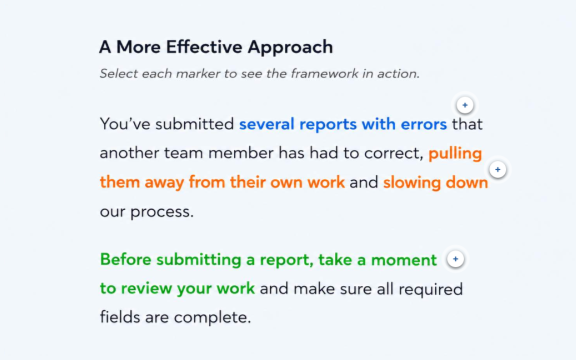
I used a realistic performance example to show how vague feedback can be transformed into a clear, actionable message.
Interactive markers break the improved feedback into its component parts, allowing learners to connect each part of the message back to the framework they just learned.
.png)
03 — PRACTICE THE DECISION
Moving from knowledge to judgment
I extended the practice beyond delivering feedback by introducing new information from the employee and asking learners to decide how they would continue the conversation.
The branching scenario provides targeted feedback for each choice, reinforcing the need to balance the employee’s perspective with accountability and the needs of the team.
Testing & Iteration
Before finalizing the course, I asked a learner who had not been involved in the design process to complete the experience independently. This helped me evaluate the course from a fresh perspective and identify opportunities to improve clarity, flow, and usability.
Fresh learner perspective
TEST
A learner completed the course independently without prior exposure to the content or design.
Approximately 9 minutes
OBSERVE
The test helped me evaluate pacing, clarity, interaction behavior, and how easily the learner could move through the experience.
Revise based on evidence
REFINE
I used the learner's experience alongside my own QA review to make targeted changes before considering the course complete.
What Changed After Testing
LEARNER FEEDBACK
“Vague” and “overly softened” felt distinct
The summary felt repetitive
Scenario feedback created role confusion
DESIGN RESPONSE
Separated the concepts to clarify the different communication problems.
DESIGN RESPONSE
Separated the concepts to clarify the different communication problems.
Reworked the section to focus on why the framework matters.
Redesigned the interaction so Jordan's dialogue and instructional feedback were clearly separated.
DESIGN RESPONSE
The summary felt repetitive
LEARNER FEEDBACK
LEARNER FEEDBACK
LEARNER FEEDBACK
Scenario feedback created role confusion
Outcome & Reflection
The final course provides new managers with a focused, practice-based experience for navigating corrective feedback conversations. By moving from a simple framework to modeled examples and a branching scenario, the experience gives learners opportunities to build understanding before applying it in context.
Designing and testing this course reinforced the importance of keeping learning focused on the performance need. It also reminded me that small design choices—how concepts are grouped, how feedback is presented, and how interactions are structured—can have a meaningful impact on learner clarity and confidence.